




Mailer Box vs Rigid Box vs Folding Carton: Which Packaging Fits?
The three main custom box formats compared on cost, feel and shipping, plus the finishes and inserts that make the unboxing.
- Updated Nov 10, 2026
- 5 min read
- Tool: Packaging finder
- By the CWF production team
The short version
- Mailer boxes are corrugated, ship on their own, and are the e-commerce standard.
- Rigid boxes feel the most premium, but they're heavy, usually ship assembled and need an outer carton for the post.
- Folding cartons are printed paperboard boxes, built for products on a shelf.
- Foil, embossing, spot UV and soft-touch add impact without changing the box.
- Start from the dieline, and always test a sample with the real product inside.
Packaging is the first thing a customer touches. It's also a real cost, one that repeats with every order you ship. The format you pick decides most of both: how it feels, what it protects, and what it costs to make, store and send. Here are the three main box formats, and when to use each.
The three formats
| Mailer box | Rigid box | Folding carton | |
|---|---|---|---|
| Made from | Corrugated board | Thick board wrapped in printed paper | Single-layer paperboard |
| Survives the post alone | Yes | Usually needs an outer carton | No, needs a shipper |
| Arrives to you | Flat | Assembled, in most cases | Flat |
| Feel | Sturdy and giftable | The most premium | Light, retail |
| Best for | E-commerce, subscriptions, PR | Luxury, gifting, launches | Beauty, small goods, shelves |
Mailer boxes
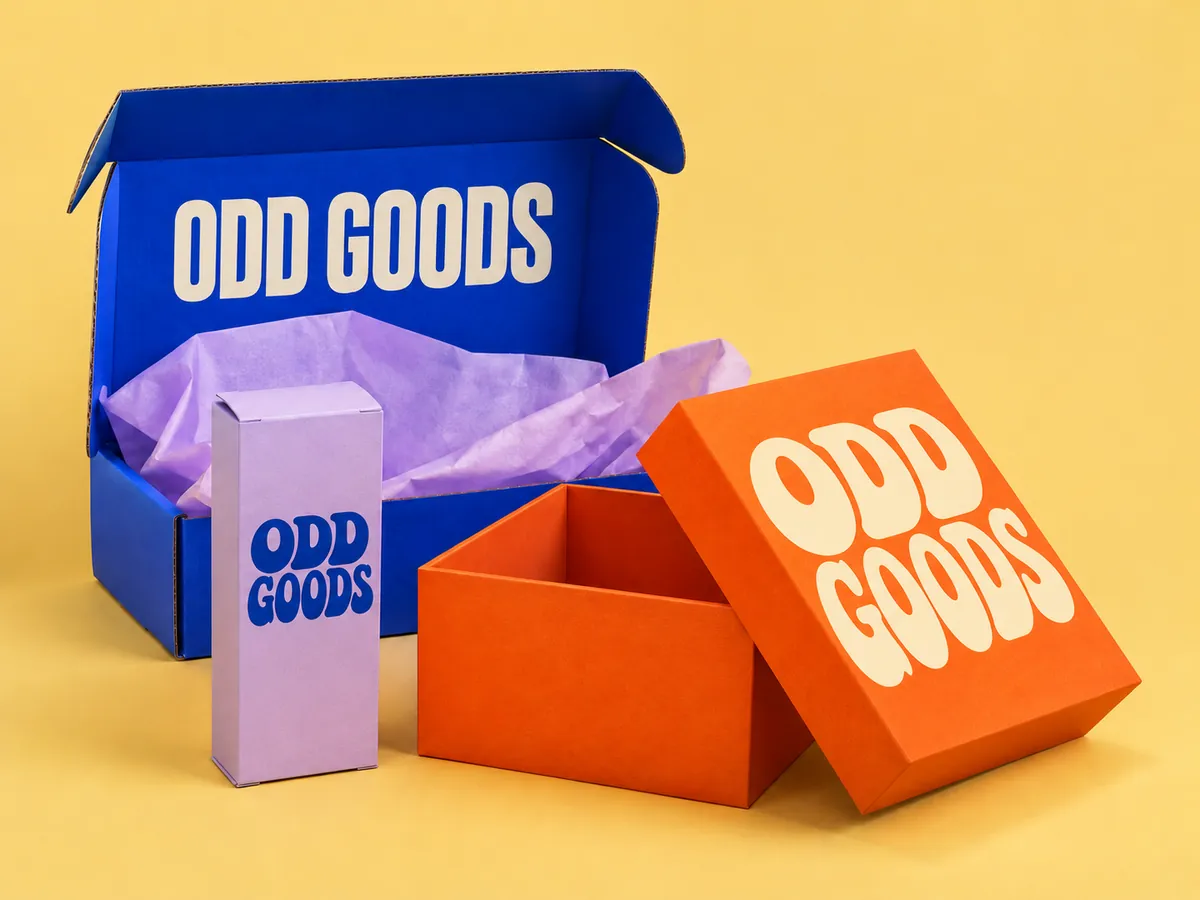
A mailer box is made from corrugated board: a wavy fluted layer between two flat liners. It folds together with tuck flaps, with no tape or glue, and it's strong enough to go through the post on its own.
Most printed mailers use E-flute, a thin flute of about 1.5 mm that prints cleanly and still protects. Heavier products can use the thicker B-flute. Mailers can be printed outside, inside or both, and the inside print is what makes the unboxing.
Rigid boxes
A rigid box is made from thick, stiff board wrapped in printed or textured paper. It's what high-end phones, watches, fragrance and jewelry come in. The lid lifts off, a drawer slides out, or a magnetic flap closes with a click.
The premium has a cost. Rigid boxes take more material and more handwork to make. Most don't fold flat, so they ship to you assembled, which means more space in the container and more space in your storeroom. And they aren't built to survive the post alone, so e-commerce orders usually need an outer shipping box too.
Collapsible rigid boxes, which fold flat and close with magnets, cut shipping and storage costs, with a slightly different construction.
Folding cartons
A folding carton is a single layer of paperboard, printed, cut and creased, then delivered flat for you to fold. Think of the box a moisturizer comes in. It's light, cheap per unit at volume, and built to look good on a shelf.
Folding cartons protect against scuffs, not drops, so products shipped to customers go inside a shipping box. Tuck-end, auto-lock bottom and sleeve styles cover most needs.
Find your format
Packaging finder
Four questions. The packaging format that fits, and why.
- Best fit
Printed mailer box
Corrugated board, usually E-flute, that folds into a box and is printed inside and out. It ships on its own and opens like a gift.
- Add: tissue and a sticker
- Add: a printed card or insert
- Also consider
Poly or compostable mailer
A printed, self-sealing bag. The lightest and cheapest way to post soft goods.
Finishes that make it
| Finish | What it does | Works on |
|---|---|---|
| Foil stamping | Metallic or colored foil, pressed on with heat | Paper wraps, cartons, mailers |
| Embossing and debossing | Raises or presses a design into the surface | Rigid boxes, cartons, paper bags |
| Spot UV | Clear gloss on chosen areas only | Laminated or coated board |
| Soft-touch lamination | A velvety matte film | Rigid boxes, cartons |
| Inside print | Color or pattern inside the box | Mailers and cartons |
One strong finish usually beats three weak ones. A foil logo on a soft-touch box says more than foil, spot UV and embossing all fighting each other.
Inserts, tissue and the rest
- Inserts hold the product still: die-cut card, molded pulp or foam. Essential for fragile or heavy items.
- Tissue and stickers wrap the product and seal the moment.
- Cards say thank you, explain care, or point to your site.
- Hang tags and labels carry the brand onto the product itself.
- Shopping bags finish the experience in a shop or at an event.
How custom packaging is made
- Size and structureMeasure the product, choose the format, and leave room for inserts and tissue.
- DielineThe flat template showing every cut, fold and glue area. Your artwork goes on top of it.
- ArtworkSet up in CMYK, with any Pantone colors and finishes on their own layers.
- SampleA plain sample checks the structure. A printed one checks the colors and finishes.
- ProductionPrinting, finishing, cutting, folding and gluing, then packing flat or assembled.
Choosing your packaging
Start with the job. Does it need to survive the post, sell on a shelf, or make a gift feel special? Then choose the format, add one or two finishes, and test a sample with the real product. See the boxes we make as a custom packaging manufacturer.
Questions
What's the difference between a mailer box and a rigid box?
A mailer box is made from corrugated board, folds flat and is strong enough to ship on its own. A rigid box is made from thick board wrapped in paper, feels more premium, usually ships assembled, and needs an outer box for the post.
Are rigid boxes more expensive?
Usually, yes. They use more material and handwork, and because most ship assembled, they cost more to transport and store. Collapsible rigid boxes bring the shipping cost down.
What is a folding carton?
A printed, single-layer paperboard box delivered flat. It's the standard for retail products like cosmetics, and goes inside a shipping box for e-commerce.
What is E-flute?
A thin corrugated board, about 1.5 mm, used for most printed mailer boxes, because it prints well and still protects the product.
What is a dieline?
The flat template of a box or bag, showing where it's cut, folded and glued. Your artwork is designed on top of it.
Written by the CWF production team. CWF makes apparel, bags, headwear, accessories, packaging and merch for brands, and runs sampling, production and quality control through a network of specialist factories. Updated Nov 10, 2026.
Got something to make? Start here.
Tell us what you have in mind. We reply within 24 hours with options, pricing and timelines.
Keep reading
 PricingCost per unit calculator
MOQ Explained: Minimum Order Quantities, and How to Get Them Down
Why minimums exist, what they really cost you, and seven honest ways to get them down. With a calculator for the real price per piece.
 ProductionTech pack checklist
What Is a Tech Pack? What Goes In One, and How to Make Yours
The document that turns your idea into something a factory can quote, sample and make the same way every time. Here's what goes in it.
 ProductionLaunch date planner
Manufacturing Lead Times: How Long Custom Production Really Takes
Every step between your brief and boxes at your door, how long each one takes, and how to plan backwards from a launch date.